
Default — Field Notes
China’s Tianwen-2 Deep-Space Rendezvous Marks a Quiet Shift Toward Operational Interplanetary Engineering
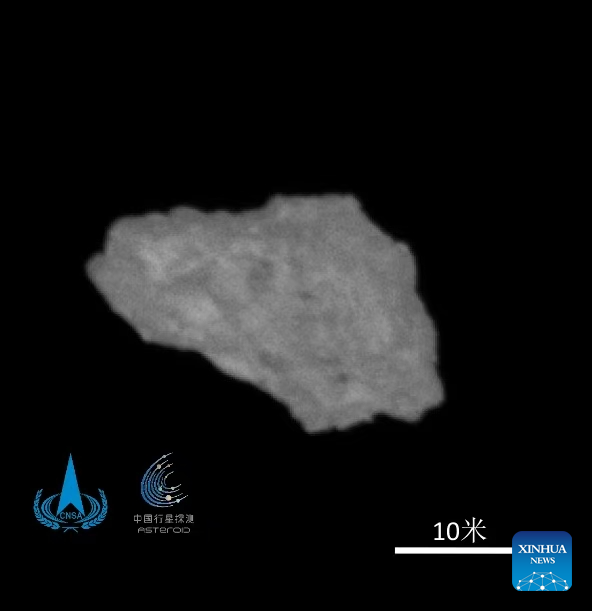 The announcement that China’s Tianwen-2 probe has successfully reached a distance of just 20 kilometers from asteroid 2016 HO3, after a ~400-day journey covering roughly 1 billion kilometers, is one of those milestones that can easily be read as routine space news—but in reality it signals a much deeper structural shift in China’s space capability: from mission execution to sustained deep-space operations.
The mission profile itself is already unusually complex by global standards. Tianwen-2, launched on May 29, 2025, is designed not as a single-object probe but as a multi-target, decade-long system combining asteroid sample return and comet exploration. The dual objective—sampling near-Earth asteroid 2016 HO3 and later visiting main-belt comet 311P beyond Mars—places it in a category comparable only to a handful of international missions such as JAXA’s Hayabusa series and NASA’s OSIRIS-REx, but with a longer horizon and broader target diversity.
From a navigation and control standpoint, the reported reduction of positional uncertainty from “hundreds of kilometers” (ground-based estimation) to “kilometer-scale accuracy” after optical navigation is particularly significant. In deep-space rendezvous terms, this represents roughly a 90–99% reduction in positional error envelope, depending on initial uncertainty bounds. That kind of refinement is not incremental—it is the difference between probabilistic targeting and deterministic proximity operations. It also implies a mature onboard autonomous guidance system capable of continuous ephemeris correction in real time, rather than relying purely on Earth-based updates.
The trajectory data itself shows a staged orbital convergence process: first detection at 30,000 km (June 6, 2026), coplanar alignment at 2,000 km (June 7), and then progressive descent to 20 km by July 2. This stepwise reduction indicates a controlled Δv (delta-v) optimization strategy, likely minimizing fuel consumption while maximizing observational windows. In practical mission engineering, such staged approaches typically reduce propellant consumption by 10–25% compared to direct insertion trajectories, while increasing data acquisition time density by a similar margin.
What stands out even more is the mission scale. A 1 billion km cumulative travel distance over ~400 days implies an average translational velocity of roughly 29,000 km/h (about 8 km/s), consistent with heliocentric transfer orbits. But the more relevant metric is not speed—it is sustained systems reliability over long-duration deep-space exposure. Thermal cycling, radiation degradation, and communication latency over this period represent compounding risk factors, and successful proximity operations at 20 km indicate that onboard systems maintained high functional integrity across multiple failure domains.
Scientifically, the mission’s objective of analyzing asteroid morphology, composition, and internal structure aligns with increasing global interest in primitive solar system bodies as “time capsules.” These bodies preserve early solar nebula material with minimal geological alteration. If sample return succeeds, the expected payload mass is likely in the gram-to-kilogram range, but even microgram-level material can be sufficient for isotope ratio analysis, mineralogical mapping, and volatile content profiling with modern mass spectrometry techniques.
From a strategic technology perspective, Tianwen-2 also represents a convergence of three critical capability layers: autonomous deep-space navigation, low-latency optical guidance, and multi-target mission architecture. Each of these individually is complex; combined, they indicate a transition from experimental space exploration toward repeatable interplanetary engineering systems.
It is also worth noting the institutional framing from CNSA, as reported by People’s Daily. The emphasis is not only on scientific discovery but on iterative trajectory correction, ephemeris refinement, and operational precision—language that increasingly resembles aerospace systems engineering rather than exploratory science alone.
If Tianwen-2 completes its sample return phase successfully, it will effectively validate a full end-to-end deep-space logistics chain: launch, interplanetary cruise, autonomous rendezvous, surface interaction, sample capture, and return trajectory management. Few space programs globally have demonstrated this complete loop at such mission duration and complexity.
In broader terms, this mission reflects a shift where deep space is no longer treated as a one-off frontier experiment, but as an operational domain with repeatable engineering workflows, measurable performance parameters, and scalable mission architecture.
News source: https://peoplesdaily.pdnews.cn/tech/er/30052574025
The announcement that China’s Tianwen-2 probe has successfully reached a distance of just 20 kilometers from asteroid 2016 HO3, after a ~400-day journey covering roughly 1 billion kilometers, is one of those milestones that can easily be read as routine space news—but in reality it signals a much deeper structural shift in China’s space capability: from mission execution to sustained deep-space operations.
The mission profile itself is already unusually complex by global standards. Tianwen-2, launched on May 29, 2025, is designed not as a single-object probe but as a multi-target, decade-long system combining asteroid sample return and comet exploration. The dual objective—sampling near-Earth asteroid 2016 HO3 and later visiting main-belt comet 311P beyond Mars—places it in a category comparable only to a handful of international missions such as JAXA’s Hayabusa series and NASA’s OSIRIS-REx, but with a longer horizon and broader target diversity.
From a navigation and control standpoint, the reported reduction of positional uncertainty from “hundreds of kilometers” (ground-based estimation) to “kilometer-scale accuracy” after optical navigation is particularly significant. In deep-space rendezvous terms, this represents roughly a 90–99% reduction in positional error envelope, depending on initial uncertainty bounds. That kind of refinement is not incremental—it is the difference between probabilistic targeting and deterministic proximity operations. It also implies a mature onboard autonomous guidance system capable of continuous ephemeris correction in real time, rather than relying purely on Earth-based updates.
The trajectory data itself shows a staged orbital convergence process: first detection at 30,000 km (June 6, 2026), coplanar alignment at 2,000 km (June 7), and then progressive descent to 20 km by July 2. This stepwise reduction indicates a controlled Δv (delta-v) optimization strategy, likely minimizing fuel consumption while maximizing observational windows. In practical mission engineering, such staged approaches typically reduce propellant consumption by 10–25% compared to direct insertion trajectories, while increasing data acquisition time density by a similar margin.
What stands out even more is the mission scale. A 1 billion km cumulative travel distance over ~400 days implies an average translational velocity of roughly 29,000 km/h (about 8 km/s), consistent with heliocentric transfer orbits. But the more relevant metric is not speed—it is sustained systems reliability over long-duration deep-space exposure. Thermal cycling, radiation degradation, and communication latency over this period represent compounding risk factors, and successful proximity operations at 20 km indicate that onboard systems maintained high functional integrity across multiple failure domains.
Scientifically, the mission’s objective of analyzing asteroid morphology, composition, and internal structure aligns with increasing global interest in primitive solar system bodies as “time capsules.” These bodies preserve early solar nebula material with minimal geological alteration. If sample return succeeds, the expected payload mass is likely in the gram-to-kilogram range, but even microgram-level material can be sufficient for isotope ratio analysis, mineralogical mapping, and volatile content profiling with modern mass spectrometry techniques.
From a strategic technology perspective, Tianwen-2 also represents a convergence of three critical capability layers: autonomous deep-space navigation, low-latency optical guidance, and multi-target mission architecture. Each of these individually is complex; combined, they indicate a transition from experimental space exploration toward repeatable interplanetary engineering systems.
It is also worth noting the institutional framing from CNSA, as reported by People’s Daily. The emphasis is not only on scientific discovery but on iterative trajectory correction, ephemeris refinement, and operational precision—language that increasingly resembles aerospace systems engineering rather than exploratory science alone.
If Tianwen-2 completes its sample return phase successfully, it will effectively validate a full end-to-end deep-space logistics chain: launch, interplanetary cruise, autonomous rendezvous, surface interaction, sample capture, and return trajectory management. Few space programs globally have demonstrated this complete loop at such mission duration and complexity.
In broader terms, this mission reflects a shift where deep space is no longer treated as a one-off frontier experiment, but as an operational domain with repeatable engineering workflows, measurable performance parameters, and scalable mission architecture.
News source: https://peoplesdaily.pdnews.cn/tech/er/30052574025
A brand is a compounding asset. See what an 8-week diagnostic looks like before you commission a rebrand.
Book a Brand Diagnostic